
What does it take to make decisions when the stakes are high, the clock is ticking and there is no obvious right answer?
That was one of the questions posed to Rotary Club of Mount Eliza members when we welcomed Mark “Squiz” Squirrell OAM for an extraordinary evening of storytelling, experience and reflection.
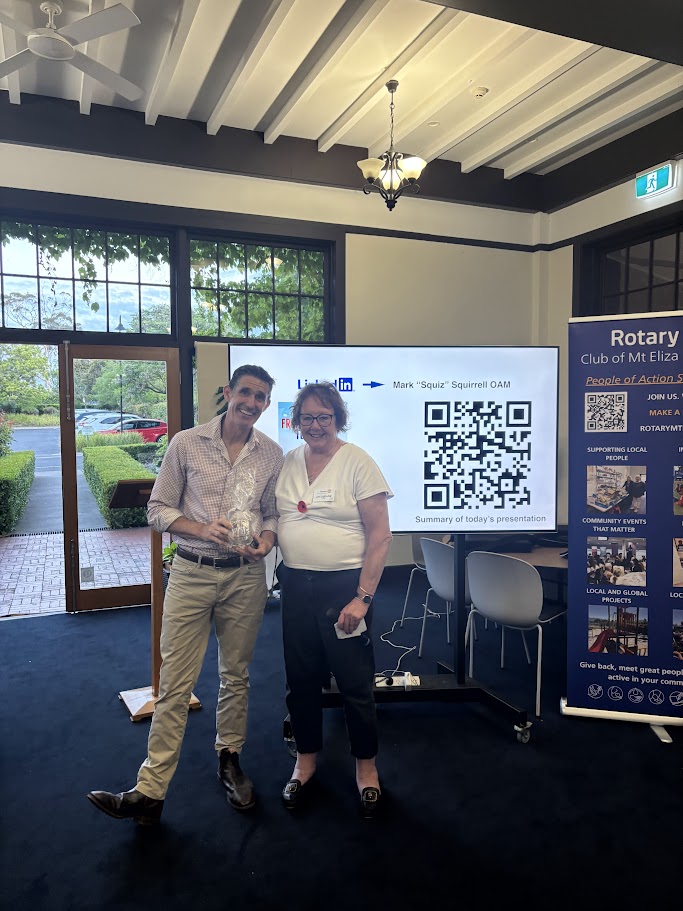
Mark’s presentation, From Arafat to Everest, took us on a journey that began with his service in the Australian Special Forces and continued through some of the world’s most challenging humanitarian environments before ultimately taking him to the summit of Mount Everest.
But this was far more than a story about adventure.
Mark shared what he learned about leadership, risk, relationships and decision-making while working in some of the world’s most complex conflict and humanitarian settings.
After serving with the Australian Commandos, Mark moved into humanitarian work, using his military experience to help protect aid workers and support the delivery of assistance in countries affected by conflict and instability.
His work with the International Rescue Committee and later the United Nations World Food Programme took him to places including East Timor, Sudan, Afghanistan, the West Bank and Gaza, Pakistan and Somalia.
Along the way, he found himself sitting across the table from some of the world's most influential people, including the late Palestinian leader Yasser Arafat.
Two of the most compelling stories of the evening placed Rotary members directly into the decision-making process.
In the first, Mark described being caught in a dangerous situation in Gaza, with armoured vehicles, Israeli Defence Force tanks, an increasingly hostile crowd and limited lines of communication. Members were asked to decide what they would do.
The lesson was not simply about choosing the right option. Mark reflected on what happens when people talk about a decision but fail to act while an opportunity still exists.
His conclusion was powerful: when there is an absence of decision-making, there is often an absence of leadership.
The second scenario took us to Pakistan, where Mark was working with the World Food Programme during a food distribution operation. A theft had triggered rumours that food supplies were running out, and a large, increasingly agitated crowd had gathered.
Again, members were asked: What would you do?
The answer was not necessarily the most obvious one.
Rather than immediately relying on local police or simply withdrawing, Mark focused on understanding the community's concerns, building trust and finding a way to keep the distribution operating safely.
For Mark, the experience reinforced the importance of relationships. The relationships built before a crisis can become the relationships that make a difference when a crisis arrives.
From humanitarian operations, Mark then took us considerably higher.
In 2006, while working with the United Nations World Food Programme, he set himself an extraordinary challenge: to climb Mount Everest and carry the World Food Programme flag to the summit as part of an international campaign to raise awareness of global hunger.
Members were taken virtually from Base Camp, through the Khumbu Icefall and Western Cwm, across the Lhotse Face and towards the South Col and summit ridge.
We heard about crevasses, extreme altitude, frostbite, exhaustion, rapidly changing weather and the sobering reality that reaching the summit is only half the journey. Most fatalities on high mountains occur on the descent.
And then came the summit.
Mark reached the top of Mount Everest carrying the World Food Programme flag, helping draw attention to the issue of global hunger and the millions of people whose daily lives are shaped by the struggle to access enough food.
Yet, perhaps surprisingly, the evening didn't finish with Everest.
It finished much closer to home.
Reflecting on his years working internationally, Mark spoke about Australia as a country that is not simply “lucky” by chance. Our education system, governance, community organisations and volunteers all contribute to creating the society we enjoy.
Rotary is part of that network.
His message was a timely reminder that service does not always require us to travel to a war zone, climb an 8,848-metre mountain or work for an international organisation.
There is enormous opportunity to make a difference right here in our own communities.
Mark spoke about how his own focus has increasingly shifted from trying to solve enormous global problems to making a contribution at a local level.
That message resonated strongly with Rotary members.
From Arafat to Everest is an extraordinary story, but at its heart it is a story about people: the people we serve, the people we work alongside, the relationships we build and the choices we make when circumstances become difficult.
Thank you to Mark “Squiz” Squirrell OAM for sharing such an honest, challenging and inspiring journey with Rotary Mount Eliza.
We came expecting an incredible story.
We left with plenty to think about.
#RotaryClubMtEliza #RotaryDistrict9815 #RotaryInternational #PeopleOfAction #ServiceAboveSelf #HumanitarianAid #Leadership #MarkSquirrell #FromArafatToEverest #WorldFoodProgramme #MountEverest #CommunityService #RotaryAustralia